
As more Americans consider relocating for affordability and opportunity, Michigan continues to stand out as a destination with diverse economic conditions. New data from January 2026 reveals a clear regional divide in unemployment rates—offering both caution and opportunity for job-seeking relocators.
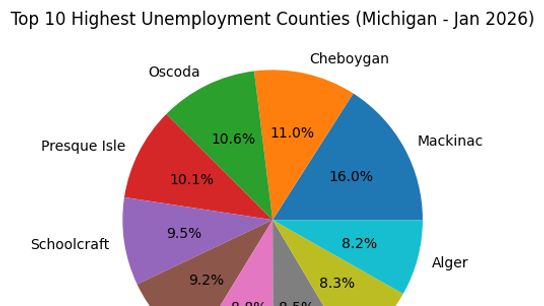
A closer look at the top 10 highest unemployment counties highlights an important trend: many of Michigan’s highest unemployment rates are concentrated in northern and rural areas, while more urban and university-driven regions remain comparatively stable.
Where Unemployment Is Highest in Michigan
According to the latest data, Mackinac County leads the state with an unemployment rate of 18.9%, followed by several other northern counties including:
- Cheboygan County: 13.0%
- Oscoda County: 12.5%
- Presque Isle County: 11.9%
- Schoolcraft County: 11.2%
- Alcona County: 10.9%
- Ogemaw County: 10.4%
- Roscommon County: 10.0%
- Montmorency County: 9.8%
- Alger County: 9.7%
These figures are significantly higher than the state’s more economically active metro areas, signaling a divide that relocators should carefully evaluate.
Why Northern Michigan Counties Show Higher Unemployment
The data tells a clear story: geography matters.
Many of the counties with the highest unemployment rates are located in Northern Michigan and the Upper Peninsula, where economies are often driven by:
- Seasonal tourism
- Small-scale manufacturing
- Limited industry diversification
For example, areas like Mackinac and Cheboygan rely heavily on tourism, which can lead to sharp employment fluctuations during off-peak seasons. This structural reliance contributes to higher unemployment rates, particularly during winter months.
Additionally, rural counties tend to have:
- Smaller labor markets
- Fewer large employers
- Limited access to high-growth industries like tech or advanced manufacturing
For relocators seeking stable, year-round employment, these factors are critical to consider.
Contrast: Stability in Michigan’s Metro Areas
While northern counties show elevated unemployment, Michigan’s metro regions present a very different picture.
Counties such as:
- Washtenaw (Ann Arbor)
- Oakland (Metro Detroit)
- Kent (Grand Rapids)
typically report much lower unemployment rates, supported by diversified economies that include:
- Healthcare and education
- Technology and research
- Advanced manufacturing and automotive innovation
These regions benefit from major employers, universities, and infrastructure that create consistent job opportunities.
What This Means for Relocators
For job seekers planning a move to Michigan, the takeaway is clear: location within the state matters just as much as the decision to relocate itself.
Best-fit regions for employment opportunities:
- Southeast Michigan (Detroit metro area)
- Ann Arbor (Washtenaw County)
- Grand Rapids (Kent County)
- Lansing (Ingham County)
These areas offer stronger job markets, higher wages, and more diverse employment options.
Source:Michigan Department of Technology, Management & Budget
Considerations for northern Michigan:
While northern counties may not offer the same job density, they can still appeal to:
- Remote workers
- Retirees
- Seasonal or tourism-based professionals
However, relocators should plan carefully and, in many cases, secure employment before making the move.
Strategic Relocation in 2026
Michigan’s economic landscape is evolving, with major investments in electric vehicles, battery manufacturing, and technology creating new opportunities—particularly in central and southern regions of the state.
For relocators, this means:
- Urban and suburban areas are driving job growth
- Rural and northern regions may offer lifestyle benefits but require employment planning
Understanding these dynamics can help individuals and families make informed decisions that align with both career goals and quality of life.
Michigan remains one of the most attractive states for relocation in 2026, thanks to its affordability and expanding industries. However, the latest unemployment data underscores an important reality: not all markets are equal.
For job-seeking relocators, targeting regions with strong economic fundamentals—while staying informed about regional disparities—can make all the difference in building a successful transition.
In today’s shifting economy, the smartest move isn’t just choosing Michigan—it’s choosing the right part of Michigan.